Powered by Blogger.
  • HOME
  • TRAVEL
    • WEEKEND WANDERLUST
    • NORTH AMERICA
    • SPAIN
    • ECUADOR
    • NEW ZEALAND
  • ABOUT
    • WHERE I'VE TRAVELED
  • FEATURED
  • CONTACT

Kelsey Social

instagram facebook twitter linkedin
 

At 6 a.m. on a Saturday morning, a long, lean silhouette practices yoga in the bedroom of a cozy home in the mountains of Boone, North Carolina.

One room over, dehydrators hum along in the kitchen. The dried flowers and branches draped along the walls tremble from the constant sound. A pitcher of freshly pressed cider sits on the table with a vanilla bean floating on top of the amber liquid. Caleb Crowell can be spotted through the foggy kitchen window examining a handful of radishes in his garden out back.


No pot of coffee is seen brewing, no stack of pancakes are waiting to be devoured.


Like today and on any Saturday morning during the spring and summer months, Caleb and his wife Megan are in their normal routines before setting up shop at the local farmer’s market.

Their business, Hold the Heat Raw Food Makery, offers a variety of raw food snacks to the small mountain community.

At the booth, bags of raw granola sit neatly arranged in woven baskets. Raw chocolate and flax chips are spread out on the table in front of Megan where she utters words like “enzymes,” “nutrients,” and “sprouted” to a customer.

The man, with a tuft of silver hair underneath a faded ball cap, picks up a sample of a Chipotle Sweet Potato Flax Chip and takes a bite.


“It tastes like a chip,” he tells me. “Except food. You know what I mean?”

Do I know what he means?

“Like, more substantial,” Megan adds.

Megan and Caleb, both 26, have been living a raw food lifestyle for the past five years. After stumbling across a raw restaurant in the Florida Keys, Caleb the former chef and lifelong health foodie along with Megan, a southern girl raised on church barbeques and Cookout milkshakes, decided to make a major lifestyle change.

“The first week was really rough,” Megan explained to me. “You think there’s nothing to eat and what the heck am I supposed to eat? You come home and there’s nothing there and you’re hungry. It’s a real problem because we’re not used to being truly hungry.”

A raw vegan diet, like Megan and Caleb’s, consists mainly of uncooked plant food including fruit, vegetables, sprouts, nuts, seeds, and grains. They believe that heating food over 115 degrees destroys the natural enzymes that aid in digestion. Without the enzymes, the body can’t easily absorb the nutrients and therefore spends more energy trying to leach nutrients from the foods we eat.

For that reason, cooked foods are out, along with anything processed, sugar, flour, caffeine, and acid-forming foods, like meat, fish, poultry, eggs and dairy.

While it may seem like a difficult lifestyle, Caleb views his eating habits as a more simplistic way of life.

“Through a lot of years we’ve processed and changed foods, we’ve always had to turn our food into something else,” he explained. “This is kind of a simplification. You can pull it out of the ground and eat it as is. It’s a beautiful thing.”


I continued to explore this “beautiful thing” that evening after accepting an invite to a raw potluck at the Crowell’s home. I debated bringing a plate of carrot sticks, but instead tapped into my lacking gourmet skills and whipped up a small bowl of guacamole.


I pulled up to the house to find Caleb and his father, Mark, tossing buckets of apples into an old fashioned press. The machine was earsplitting as it clinked and clanked, but Mark shouted instructions over the noise as Caleb used strength developed through years of teaching yoga to turn the wheel and churn out fresh cider.


Mark, an ex- vegetarian and former owner of Bean Mountain Tofu, explained how he’s always had an interest in health food and inflicted these views on his family, but Caleb is the only one to adopt the raw food lifestyle.


“A lot of the family thinks he’s no fun anymore since he doesn’t eat the things he use to,” Mark said. “But once you’re around him he’ll just dive into a giant salad and nobody notices that [he’s] not eating the same as everybody else.”


While continuing to emphasize his support of his son and daughter-in-law, Mark mentioned their wedding last summer.


In their own backyard, Megan and Caleb were married in front of 300 of their friends and family who celebrated with a 100 percent raw buffet catered by Hold the Heat Raw Food Makery (a.k.a. Megan and Caleb).


With a table full of options like “bread sticks” with pesto, romain tacos with corn salad, radish ravioli, tomato tart, raw rosemary cookies, and raspberry sorbet, nobody noticed the absence of a white-frosted wedding cake.


“They didn’t make anything for all the old son in laws and uncles who sat there and weren’t going to eat anything.” Mark said. “They didn’t like bring some chicken nuggets for those people. They just made as much good food as they could, but all adhering to their principals. “It was just drop dead gorgeous. It was so pretty, you had to eat it, you had to try it. All these hundreds of people, all the old church ladies, everybody just say there and ate and ate. It was amazing.”


As the sun began to set, Mark and I ventured into the house where about 12 people gathered in a small circle. Initially, I felt like I was participating in a support group like “Raw Foodists Anonymous” as the introductions began:


“I’m Megan and I’m here because raw food is what I do…” but as she continued, she explained the pumpkin cashew pudding she struggled making and a marinated kale salad thrown together for the group. Her passion and excitement to share the importance and benefits of a raw food diet showed through animated hand gestures and a bouncing demeanor.


A woman in the circle, JoAnn, a raw foodist of two years explained meeting Megan and Caleb at the farmers market months earlier. After hearing from her friend Sally that there were raw foodists she went to check it out.


“Oh, we have raw food community, I’m so thrilled, how many are there?” JoAnn explained as she told the story. “Megan said, well there’s me, there’s Caleb, and there is you!’ So that was that.”


Now with interest from the farmer’s market, local wedding guests, and customers who’ve seen Hold the Heat products at Bare Essentials health food store, monthly potlucks have grown to gather 40 or 50 guests at times.


“We get a wide range of people and we try to tell them as much information as we can about raw foods and why we don’t heat above115 degrees and why this could be a good alternative to your regular [diet],” Megan said.


Overall, the main goal of the couple is to promote a healthy lifestyle.


“And were living proof,” Caleb added.


Share
Tweet
Pin
Share
No comments
After another recurring conversation with my parents about the future date of my flight home, my next job, money, safety, etc...  I coincidently stumbled across this letter that another traveling friend had shared.


To my Mom and Dad, and all the other Moms and Dads of travelers (or future travelers), please read and try to understand...


Dear Parents:

It’s me, Rachel. We haven’t formally met. I am not a licensed medical or psychological professional. I’m only a writer – a profession that requires little in the way of legitimate qualifications. Still, I hope you’ll hear me out. I’ve heard that your daughters – young women in their late teens and early twenties – have of late been considering the idea that they might be of the constitution and comportment to have some adventures. Maybe your daughter is a new high school graduate or in the middle of her college years or just graduated from some ivy-covered university where she spent hours poring over literature and philosophy and debating gender performance. Your daughter is educated and free-spirited and full of wonder, thanks in large part to the opportunities you have provided her.

Share
Tweet
Pin
Share
3 comments
I sleep in an open-air cabana. There is no difference between inside and out. Each night as I close my eyes, I listen to the rustle of bats circling the room and the steady hum of a million different insects occupying the darkness. The frogs seem to croak the name of one of the workers on the farm: “Ed-garrrr,” they say, “Eddd-garrr.”

One night, a catfight ventured to the fourth floor where I sleep. The animals hissed and snarled while sprinting back and forth along the corridor of the room between sleeping girls. I shot up in my bed and attempted to shine my headlamp on the cats, but they were moving quickly and my pupils were still adjusting to the white light. I couldn’t catch a glimpse before they chased one another down the ladder-like staircase.

The next morning our floor was covered with fur and cat poop. We went downstairs for chores and found our fluffy farm pet lying dead under the bamboo sofa. It is still somewhat of a mystery what killed him. My guess is an ocelot.

Needless to say, the nights are never quiet, but they are always somewhat peaceful. I’m used to the sounds now. I find them comforting and familiar. I know the roosters begin to crow around 4:30 a.m. – even the little tan one with a broken vocal box. Leo usually passes by on his motorbike around 6 a.m. -- a signal for me to get out of bed. And I can now recognize the steady, high-pitched rumble of his moto, which is different from Edgar or Danilo.

I also know the sounds of the gates scattered around the property – the subtle, low drone of the main entrance or the long creak of the gate near the pigpens.

The ambient noise of this area is so different from what I know: there are no passing airplanes, no highways full of traffic in the distance, no TVs. At first the silence felt creepy, but now I think electric noise would be creepier.


Share
Tweet
Pin
Share
No comments
One pineapple takes a year to grow. A full year. Or more. At the farm, we eat at least one pineapple for breakfast every morning. The outer peel is boiled in water to make tea and the rest is chopped up and served with other fruit and granola. Even the center core is eaten because it is fully ripe, soft and juicing with flavor.

I have much more appreciation for pineapple after realizing the amount of time it takes to grow just one fruit. I've found that working in the garden planting, weeding, seeding, etc. makes you better appreciate the food on your table.

It is always exciting when someone brings a fresh bunch of bananas from the garden into the kitchen, but I also now know that another one of our banana trees is now dying because they only fruit once.

While we usually harvest food from the garden and bring it to the señoras (two older women who live in the community and cook and clean on the farm), the other morning we decided to make our own lunch, so Laura (New Zealand), Angela (Colorado) and I brought a few kids along to the garden for a harvesting and snacking adventure.

We walked through the rows of vegetables sucking on chunks of sugar cane and the pulp of cacao seeds while picking what looked ripe and appealed to our grumbling stomachs. The final product was grilled onions, sautéed kale, a big raw salad full of peppers and tomatoes, and of course rice. We also froze bananas for some blended banana "ice cream" later on.

There is something special about growing food, harvesting it from the garden, cooking it yourself and sharing the meal with people you care about.


The inside of the cacao fruit
Share
Tweet
Pin
Share
2 comments
“The Skins are in first place right now,” my Dad’s voice echoed through a basic Ecuadorian cell phone.

Standing at the top of a hill, with one hand pressed against the bark of a tree, I could get sparse service to call home.

It was a steep, twenty-minute hike following an old barbed wire fence past grazing cattle to reach the top. Red ants, about the length of a nickel, carried leaves up and down the tree and over my fingertips. No person was insight. I gazed over valleys spotted with banana trees under a bluish-grey sky.

It wasn’t until this moment that I realized how much my daily life has changed and how remote the farm really is. We don’t have available phone service, television or Internet. To get to the closest town with these luxuries, you either have to walk two and a half hours to the paved road to catch a ride, or arrange some other alternative mode of transportation…. donkey ride, anyone?

As a person who is slightly obsessed with the Internet and pursuing a career in the media business, I’m shocked how easy it has been to transition into a world without modern technology. Somehow, long chats with new friends from all over the world, evening card games and late-night chocolate making serve as good distractions from the comforts of technology.

And while I wouldn’t mind watching the Redskins sometime, the only games I’m currently concerned with are evening football (soccer, of course) matches in the community. More on soccer in Ecuador soon…
Share
Tweet
Pin
Share
No comments
Tucked between a few rolling hills on the coast of Ecuador, 14 kilometers from a small, two-street surf town, lies Rio Muchacho Organic Farm.

After a ride in an open-air bus, a bouncy truck bed, the back of a dirt bike, or on an old horse… you will eventually arrive at the gate of the farm, my home for the next seven months.

Spread across these 10 hectares of land is not only my home but the home for numerous herbs and vegetables, various animals, Ecuadorian workers and volunteers from around the world.

I’m here to work for Rio Muchacho as a marketing intern to promote the farm and other ecotourism opportunities through websites, blogs and social media. Since most of my work requires internet, which is not available on the farm, I spend about three days a week in a nearby town and the rest of my time working with the animals and in the garden.

While studying journalism in college, I never imagined I would be waking up every morning to shovel poop in peg pens, but this lifestyle seems to work out.

Days here start early at 6:30 a.m. for morning chores with the animals. Each animal (cows, pigs, chickens, guinea pigs, horses, dogs, a rabbit, a goat and a boar) serves a particular role to keep the farm running. And most of these roles involve poop.

Rio Muchacho is a self-sustaining, organic, pescatarian (we eat fish!) farm. We grow the majority of our food and use organic resources to build and survive. While the goal of the farm is to be sustainable, it also strives to educate people within the community as well as across the world with ideas of how an individual can avoid negatively impacting the environment.

So we begin each day shoveling poop. The food we eat comes from the garden. We feed all scraps and leftovers to the pigs. The pigs digest the food and we scoop their poop to mix with sawdust and excrements from other animals for compost. The compost eventually gets used to fertilize the soil in the garden where the process starts all over again.

The way we live works in circles. Everything we take from the Earth eventually gets returned.
"El dinero no se puede comer" or... "You can't eat money"


Share
Tweet
Pin
Share
No comments
I went bowling a few weeks ago with my hometown friends. The bowling alley where we spent
summer nights as kids. The same fluorescent lights. The same grey haired man behind the counter. The same ugly clown shoes. And the same group of friends I’ve grown up with over the last decade.

While sipping my beer and throwing numerous gutter balls, I realized how much I enjoy the time I spend with these people.

Sure, I’ve made many friends while traveling, throughout college and as a “young adult.” They are, with no doubt, great people. Hilarious. Motivated. Fun.

But for some reason they don’t pinch my heart like this hometown group. Maybe because I have never wrestled them in the basement. I have never locked their arms and ran into a winter ocean. I have never snuck in or out of the house with them or carpooled to the movies in their mom’s mini van.

This all must have something to do with why the friends we make in our “adult-ish” years are never as close as the ones we make as kids. I’ve shared so many “firsts” with these people I don’t think I’ll ever be able to let them go.

We didn’t know anything as kids, but thought we knew it all. We were awkward and confused. Our emotions were fresh and we explored them with our friends.

I’ve learned a lot with these people and have many times I wish I could forget. But instead we can look at those memories today and burst out laughing, or crying, or just shake our heads at the simplest things.

They will be the ones forever smiling in pictures on my wall. Even when, years from now, a new friend will glance at the photo and have no clue who the happy faces belong to, I still want to look at them everyday.

And when we’re back in the same town together, from different cities or time zones or countries, we’ll get together over a few cases of cheap beer and waste away the night. And laugh. Because I never seem to laugh the same way with other people.

That's what I get when I see my old friends. Cheep beer, bad jokes, good memories and a sense of home. I wouldn’t have it any other way.


Share
Tweet
Pin
Share
No comments
When I first landed in Quito, my legs were shaky. The airplane was unable to touch ground due to strong winds above the city, so we flew South to Guayaquil to get fuel and sit in the runway... and wait.

At midnight on September 2nd, three hours after my scheduled arrival, I walked alone through the crowds in the Quito airport. Spanish conversations buzzed around me, but I couldn't seem to recall a single phrase I had learned in the previous weeks. I needed to take a taxi to find a hostel in La Mariscal District (A.K.A. Gringolandia), but thoughts ran through my head of dangerous cab drivers and petty crimes in the city.

A woman working the desk recommended the taxi of one older man, so I hopped in his van and trusted he would take me where I asked. While we drove through the desolate city, I sat clutching my backpack and attempting to swallow the knot that was forming in my throat. I couldn't help but question why I had chosen to move to this unfamiliar country where I had no friends and could barely speak the language. I had never felt so alone.

A combination of jet lag, frustration with my Spanish and a bit of confusion made me want to curl up in that backseat and cry. It took complete concentration to hold in the tears and convince myself that these uncomfortable situations help you to grow into a stronger person.

So, I sucked it up, checked into a hostel and fell asleep in the top bunk of a room full of strangers. $7 for a bed, a warm shower and free breakfast.

The next morning I staggered down to the dining room for toast and cereal with several other sleepy backpackers. The good thing about travelers is we are naturally curious people -- Why else would we want to see the world other than to satisfy scratching the itch of curiosity?

And quick friends are easy to make when staying in hostels. Everyone has their own unique stories to share of where they've been, what they've done and of course where they're going. So conversations at breakfast naturally flowed and initial plans for a walk in the park with some Ecuadorians also led to a trip to the outdoor market, sharing a burrito with an Australian girl, cervezas and broken Spanish around a patio table, failed attempts at salsa dancing and a secret after-party at an underground diskoteka.

Quito is a mix of the old and new cultures of Ecuador. La Mariscal district is full of young people, hostels, modern restaurants and bars, while the old town has colorful plazas, rows of old buildings and historic churches watched over by El Panecillo, the virgin angel statue.

Along the street, little boys with dirt on their faces want to shine your shoes for a quarter and young girls selling Chicklets look up at you with sad brown eyes. It's not easy saying no.

After spending a week in the capital city, I was able to get somewhat accustomed to the Ecuadorian lifestyle and also register my visa. But seven days of commotion left me eager to get to the tranquillo atmosphere of the farm.


Share
Tweet
Pin
Share
1 comments

Goodbyes always seem so dramatic in the movies. Eyes are filled with tears, men tend to run along the side of trains and the weather just happens to be dreary just like that foggy night in Casablanca with trench coats and the ever famous farewell line: “Here’s looking at you, kid.”

These scenes are never tearjerkers for me. I wouldn’t necessarily classify myself as “movie crier” at all, but the whole concept of saying goodbye is often overly portrayed as melodramatic.

I’ve been confident about my opinion on this sappy subject for years until, unfortunately, a few weeks ago.

I wiped away tears while taking the elevator down to the lobby of my apartment building. I needed to throw bags of trash into the dumpster, bags filled with a pair of my worn converse, disregarded scribbles of class notes and maps that had been pinned to my walls for months – basically anything I could trash in order to lighten my luggage.

I was focused on moving out of my flat in time to catch a flight to the South Island of New Zealand where I would be traveling for the following weeks.

As I walked into the lobby, I saw the tear-stained faces of the people I spent the last five months getting to know. The people from countries scattered around the world and all across America that were so different from me, but quickly became my best friends.

I didn’t decide to study abroad to make new friends or meet people, I wanted to see the world and become familiar with the country.

I am satisfied with my relationship with New Zealand, I immersed myself into the culture and traveled more within the country in five months than I have around the U.S. my entire life, but during the last days, it wasn’t the relationship with the country that concerned me, it was ending the relationships with the people I shared the time.

So I walked to and from the dumpster without acknowledging my emotional friends and headed back up to my flat to grab my bags, along with my composure.

It’s not easy accepting the fact that the world is a large place and you may never see these people ever again.

Yes, the Internet allows us to Skype, email and easily keep in touch, but the understanding sits in the back of our minds that the bond will never be same.

Once I was able to get my emotions under control, I joined my group of friends in the lobby for the final farewells.

Most goodbyes are awkward. No one ever knows the right words to say, but I’ve realized now that most things are better left unsaid.

That unsatisfied, incomplete feeling will always exist after a sincere goodbye and I recognize that there is nothing one can say or do to fulfill it.

So we all cried and hugged and sometimes didn’t say a word while onlookers stared at us, most not able to comprehend the situation as it is something that the majority of people have never experienced and may never will.

Leaving and losing such valuable relationships is not an experience I would recommend to others, but it is a part of traveling that one cannot avoid.

After returning home to my family and friends, I still feel a bit of emptiness and I’m only now realizing that it will never go away, but only be ignored, as the memories are more important. So far it seems easier to remember than to miss.

I was reading a book during the end of my time abroad and posted a quote from it on my wall for inspiration and would now recommend it to any other traveler who inevitably faces the final goodbye.

“So many people enter and leave your life. Hundreds of thousands of people! You have to keep the door open so they can come in, but it also means you have to let them go.”

-Extremely Loud and Incredibly Close by Jonathan Safran Foer

Share
Tweet
Pin
Share
No comments
The month of October was gone before I knew it. The semester was quickly coming to an end, which meant exams were fast approaching and although we weren’t speaking about it, we all knew in the back of our minds that we would soon be saying our goodbyes.


Back home, the excitement for Halloween builds up weeks before the final night. Decorations are displayed across the aisles in grocery stores, battery-powered singing bats appear on porches along with mock cobwebs on the bushes and of course costume ideas are discussed daily. Halloween may even be the biggest holiday for university students, it’s right up there with St. Patrick’s Day and Cinco de Mayo – basically just another excuse to celebrate alcohol.


This year, I was sitting with friends on a blanket in Albert Park enjoying the sunshine when it was brought up that it was the 31st of October. We planned on going to town that evening, but hadn’t necessarily prepared any costumes. A few ideas floated around until we decided to dress up as our guy friends. We have a close group of unique friends each with very distinguishable characteristics, so it wouldn’t be difficult to imitate them.


That night, we snuck into rooms to steal their clothes and supplies for our costumes. We got ready in secret and revealed ourselves altogether – it was obvious to everyone who we were impersonating.


Roberta dressed as our Maori friend Barry. She wore his signature hat and vest combo with a stain down the front of his white shirt and didn’t put down the Diesel (Burbon and Coke) can all night.


Audrey had crazy hair held in place with a red bandana and plaid button down shirt. She wore a thick hemp necklace and enthusiastically babbled about the environment all night, perfectly imitating Mason from Seattle.


Kristen successfully stole our Fijian friend Tim’s “Bula skirt” and brown vest. She even carried around a laundry basket to represent his frequent trips to “do laundry.”


Annie perfectly portrayed Mark with basic khakis and a full beard. She even chewed on hard spaghetti noodles for the full effect.


I dressed as my Norwegian friend Mads. I stole one of his signature cardigans and wore it with a beanie and bright wayfarer sunglasses. I changed my pants three different times to find the right pair, and each time they got brighter and tighter, ending with a skinny cut turquoise pair.


Share
Tweet
Pin
Share
No comments
“O for awesome!” is a common phrase used to express a deeper feeling of “Sweet As” and when your response toward the happening is greater than just plain awesome.


Surprisingly, kiwi’s are generally intelligent people. They may jump off of tall towers with rubber bands strapped to their feet and drive on the wrong side of the road, but they know that awesome is not spelled with an “o”.


So, where did this popular expression originate?


On October 10, 1992, Olympic heavyweight boxing champion David Tua appeared on a celebrity version of New Zealand’s Wheel of Fortune.


When his turn arrived, he aggressively spun the wheel and proudly asked for an “O… for awesome!”


Ever since the show aired, the phrase has stuck and its popularity continues to grow across the land of the long white cloud.


And now, thanks to Tua, I have my favorite New Zealand souvenir that will not make sense to most, if not all, Americans who see it.


Share
Tweet
Pin
Share
No comments
My Kiwi flatmates (Anna, Jess and Lynelle) all move out tomorrow. It is going to be strange not having them here during these last weeks and I am not looking forward to it. I have become so used to being around them while they make fun of my accent or the things I eat or basically anything American thing I do. I am not ready to live in a quiet apartment and face the reality that I may never see them again.

Last night, to celebrate the end of their year in Auckland, we went out for dinner and got Magnum ice cream bars for dessert. This was my first Magnum even after hearing much praise from international students and kiwi's alike. I was not disappointed, but glad I did not discover this calorie-filled delicacy until the end of my time here.

When I returned to my room that night, I found a nice farewell gift from my flat ties:


Share
Tweet
Pin
Share
No comments
Nov. 16th - 20th:

After receiving an invite from a friend that was too good to refuse, I booked a flight to Christchurch and made my way, for the first time, to the South Island.

I packed the necessities into my backpack and made my way to the airport for the cheap flight I booked as a "carry-on only" passenger. The man at the desk took one look at my bag and requested $80 without explanation. Apparently it was too big to fit in the overhead compartment which I understood after attempting to squeeze it in the imitation box at the check-in line.

I desperately pleaded for him to let me go because I could not possibly throw away $80 to an apathetic airline. He continued to refuse so I desperately rearranged my pack, pulling on every strap possible to shrink it down in size, and comfortably tucked my sleeping bag under my arm. After holding up the line behind me and causing the man much annoyance, he waved me on free of charge.

When I arrived in Christchurch, Mark had already been traveling for three days and he picked me up in our rental car. He had found a deal to rent a car for $1 a day as long as you picked it up in Christchurch and returned it in Auckland. We now had the next six days to explore New Zealand before getting me back to my 2 o'clock class on Thursday afternoon.

We immediately made our way to the west coast, breaking to sleep once at a pull-off point on the side of the road. Once we arrived, we headed North, frequently stopping to see anything and everything we desired.

Mark drove the whole way. We decided not to purchase the car insurance, so I was perfectly happy letting him stay behind the wheel. Along the trip, our glove box became the storage unit for the variety of brochures, pamphlets, maps and guidebooks we collected. Since the remote areas of New Zealand (basically the entirety of the South Island) don't have radio stations, I read aloud from the booklets while he drove.

We camped wherever we were when night fell and Mark cooked some great pasta dinners on the camping stove. We woke up early each morning, drank a warm drink, ate some muesli and headed on to our next destination.


Kia birds are one of few alpine parrots in the world and it can only be found on the South Island. We met this guy at a look out point on my second day on the island. He was not the slightest bit shy.


After visiting Fox and Franz Joseph Glaciers, we drove to Gillespies Beach to camp for the night. When we got there, the rain cleared and we arrived just in time to catch the sunset. We sat next to the fire, ate dinner and drank wine while watching the sun go down over the water.


We arrived at Lake Matheson early the next morning to catch the reflection of Mt. Cook and Mt. Tasman in the calm water.


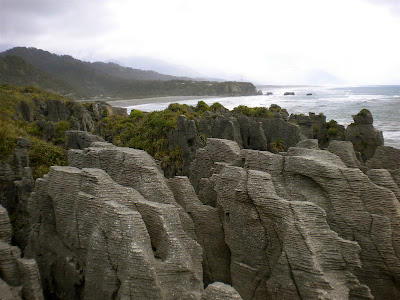
Then we ventured on and saw the pancake rocks in Punakaiki and hiked the Truman Track down to the beach.


We continued north to the Abel Tasman, stopping along the way to cross New Zealand's longest swing bridge at 110 meters long suspending over the Buller Gorge.


After hiking a little of the Abel Tasman track and relaxing on the golden sand at Kaiteriteri Bay, we drove east into rain to sleep in Nelson for the night before catching the interisland ferry the next morning. Because of the bad weather, we splurged and payed $12 to sleep in huts at the Pelorus Outdoor Center campground. There were six two-person huts that shared showers (with warm water!), bathrooms, a kitchen, and common area with a fireplace.

The main room was an old school house so it had a large open area with old couches and chairs. The whole place may sound luxurious, but there was no heating in the huts where we slept on thin mattresses on top of wood planks, mice ran freely around the old kitchen, and the cobwebs on the ceilings paralleled the dirt on the floor. At the time, it was a refreshing sanctuary and I would return in a heartbeat.

While we were there, one of the other huts was shared by two Australian fisherman. Neville and Steve were visiting New Zealand to fish for trout. We drank tea and they entertained us late into the night with hilarious stories about their lives in Australia. 72-year-old Neville bounced around and told us about living all over the world. I would have never imagined a man so old to have that much energy and enthusiasm. He explained to us that over the past decade, each time he celebrates a birthday he takes a year off of his life instead of adding one on. This idea is one I do not want to forget as I get older.

Steve was quite a bit younger and in his 50s. He told us he even has trouble keeping up with Neville. He explained that Neville has taught him to laugh more and as he gets older he has learned to take life less seriously.

It was great talking to these old fisherman and I can't say I've ever experienced anything like it. One thing Neville said while talking about his travels around the world is a thought that I want keep in mind while my time here is New Zealand is slowly coming to an end:

"It is the hopeful journey that is more important than the arrival home."

So, the next morning our journey "home" (to Auckland) continued and we hopped on the Interisland ferry to return to the North Island.


More to come about adventures in the North Island on the last day of the trip...
Share
Tweet
Pin
Share
2 comments
Older Posts

About Kelsey

About Me
...
Hey there! I'm Kelsey. I'm attempting to create a life full of adventure and excitement. After living and traveling abroad for years, I now live a more settled life in Washington, DC while working in social media and traveling every chance I get. I'm a strong advocate for #WeekendWanderlust. Let’s adventure!

FOLLOW @KELSEYSOCIAL

Search

recent posts

Labels

Ecuador New Zealand hiking north america snowboarding spain travel weekend wanderlust

Blog Archive

  • ▼  2018 (5)
    • ▼  September (1)
      • Road Tripping to Acadia National Park & White Moun...
    • ►  June (1)
    • ►  April (1)
    • ►  March (1)
    • ►  January (1)
  • ►  2017 (10)
    • ►  December (3)
    • ►  June (1)
    • ►  April (2)
    • ►  March (1)
    • ►  February (2)
    • ►  January (1)
  • ►  2016 (3)
    • ►  December (2)
    • ►  March (1)
  • ►  2015 (7)
    • ►  November (1)
    • ►  July (3)
    • ►  June (1)
    • ►  May (1)
    • ►  February (1)
  • ►  2014 (16)
    • ►  December (1)
    • ►  November (1)
    • ►  October (1)
    • ►  June (1)
    • ►  May (2)
    • ►  March (2)
    • ►  February (6)
    • ►  January (2)
  • ►  2013 (23)
    • ►  December (4)
    • ►  November (3)
    • ►  October (8)
    • ►  September (4)
    • ►  August (3)
    • ►  July (1)
  • ►  2012 (4)
    • ►  November (1)
    • ►  September (1)
    • ►  June (1)
    • ►  May (1)
  • ►  2011 (9)
    • ►  December (1)
    • ►  November (1)
    • ►  October (4)
    • ►  September (3)
  • ►  2010 (2)
    • ►  April (2)
  • ►  2009 (28)
    • ►  December (2)
    • ►  November (4)
    • ►  October (5)
    • ►  September (4)
    • ►  August (5)
    • ►  July (6)
    • ►  May (1)
    • ►  April (1)
by BeautyTemplates | Distributed by Gooyaabi Templates